
Moving with the times, part 2: tubeless tyres
First trial, 2019
My first attempt at adopting tubeless tyre technology came after I bought a Shand Stoater in December 2018. I was intending to set it up as a low maintenance commuter bike. Bad timing really, as in 2020 we all went into Covid lockdown, and I ended up mainly working from home!
Anyway, as a low maintenance bike I’d specced the bike with a Rohloff 14 speed hub gear and a belt drive. So an annual oil change of the hub and no lubrication of the chain. It also came with tubeless ready rims, but with ordinary clincher tyres. I navigated the complexity of Schwalbe tyre nomenclature and bought a pair of appropriate tubeless ready tyres, tubeless rim tape, sealant and a pair of valves. Setup was pretty straightforward, I didn’t even need any specialist pump attachments.
The problems surfaced on my second ride on the bike after setting the tubeless tyres up. The first ride was a commute to work, but on the return trip I suffered a puncture that wouldn’t seal properly. I did make it home withe several stops to top up the air in the tyre. Back home I tried to plug the hole but was unsuccessful. Maybe that was down to inexperience and ineptitude. The whole situation therefore was very messy and I quickly decided to go back to inner tubes.
Second trial, 2026
Roll forward to 2026 and I was running a pair of tubeless wheels on a TT bike. I was using Continental GP5000 TT tubeless ready tyres (albeit with TPU tubes), so I thought maybe I should give that tubeless a second go.
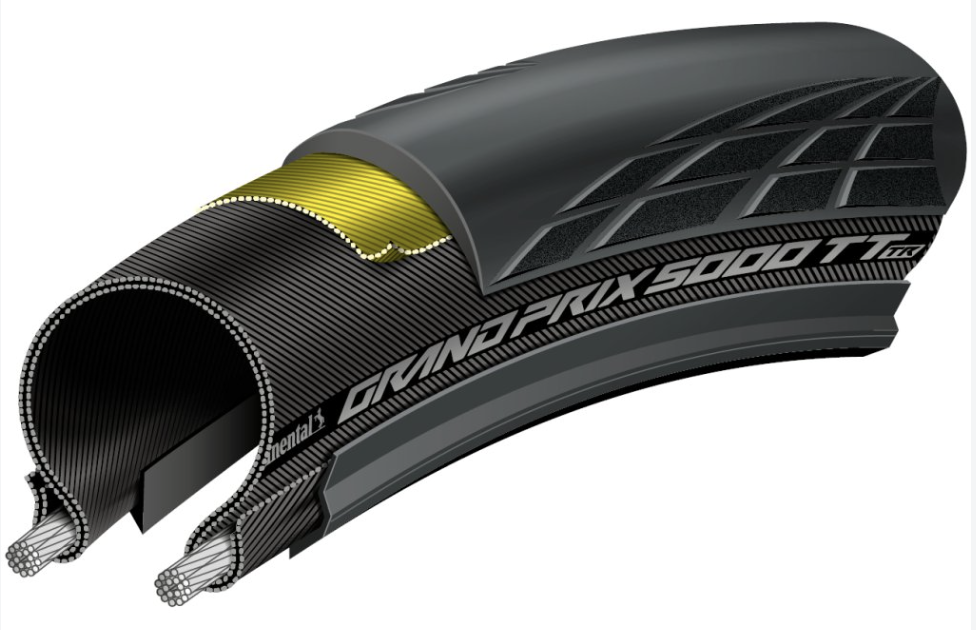
Continental GP5000 TT tubeless ready tyre. A particularly good tyre, with or without an inner tube.
Once again setup was relatively painless, except some issues fitting the valve to the disc wheel, owing to the small valve cutout making it a little hard to tighten it up against the rim. Once sorted both tyres held pressure well, easily as good at the TPU inner tubes.
I rode the P5 tubeless through most of the season. I didn’t have any punctures. But then again, I didn’t have any punctures on my other bikes which all have inner tubes. I haven’t seen any evidence of a sealed puncture on those wheels. So I don’t think I can draw any conclusions there!
Is tubeless worth it?
As a road cyclist, I don’t really see any advantages to outweigh the general hassle in setting tubless tyres up and all the sealant topping up that’s needed. I certainly wouldn’t want to have to deal with tubeless on several bikes.
Fewer punctures? I don’t really get many punctures, and replacing an inner tube isn’t particularly arduous, nor does it have the potential for generating sticky mess!
Avoid impact punctures? I don’t think I’ve had an impact (i.e. snakebite) puncture since I restarted cycling 36 years ago. So for me as a road cyclist it’s not an issue.
Better rolling resistance? I’ve recently been riding TPU tubes, and before that latex tubes, on my TT bikes. I can’t say that I’ve noticed any great improvement when I switched the P5 to tubeless. Maybe there’s a benefit, but if so it’s marginal at best.
Less hassle? I hear advocates arguing that avoiding punctures means that tubeless systems mean lesss roadside repair hassle. But I dread getting an unsealable puncture with all the mess involved in getting the tubeless valve out and an inner tube in. In my experience, setting up tubeless tyres is a fair bit more hassle than mounting a tyre and tube.
But I can see the benefits for off road cycling, on gravel or MTBs, but much less so for road bikes. I’m expecting to change the TT bike back to TPU tubes when the tyres wear to the point they will be replaced.
When you subscribe to the blog, we will send you an e-mail when there are new updates on the site so you wouldn't miss them.

Comments